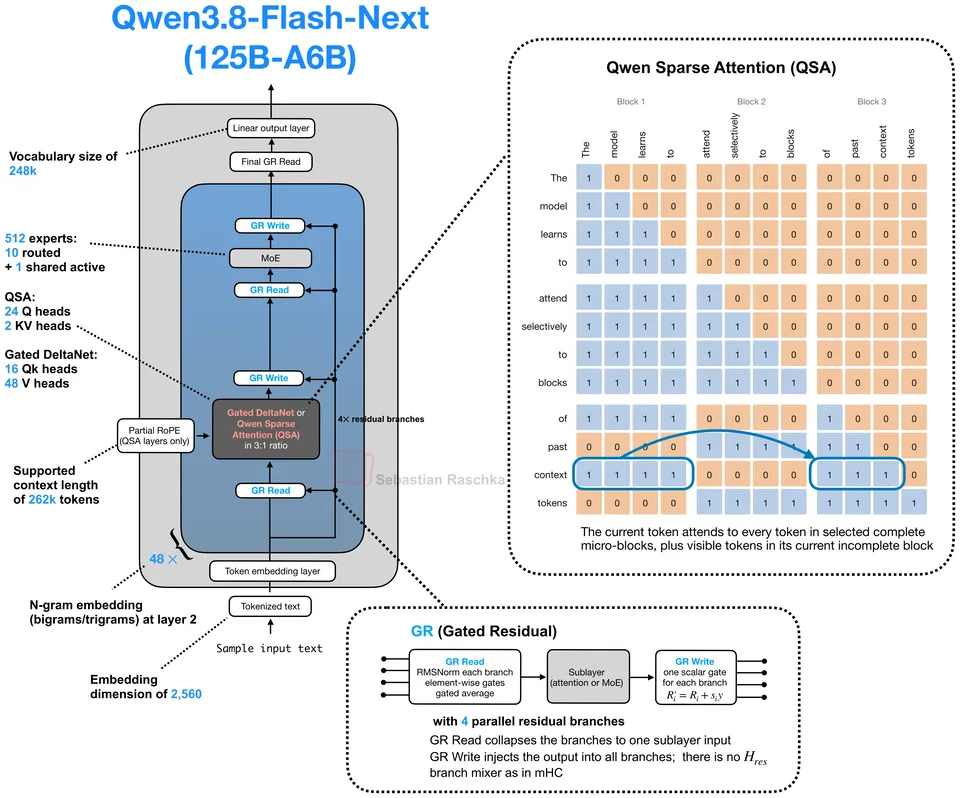
Alibaba Cloud, released 2026-08-26. Hybrid MoE decoder, 125B total, 6B active, 256K context. Attention: 3:1 Gated DeltaNet and Qwen Sparse Attention (QSA).
Efficiency & sharing · PLE
Each layer gets its own token-specific embedding signal from a large lookup table.
Lookup tables are cheap to run and can live outside fast memory, so small models can store extra token-specific information per layer without making the transformer stack itself more expensive.
It is why Gemma 4 E2B is described as 2.3B effective parameters but 5.1B including embeddings. The “E” stands for effective.
Models in the atlas using PLE, per half-year of release.
Alibaba Cloud, released 2026-08-26. Hybrid MoE decoder, 125B total, 6B active, 256K context. Attention: 3:1 Gated DeltaNet and Qwen Sparse Attention (QSA).

Google, released 2026-04-02. Dense decoder, 5.1B parameters, 128K context. Attention: Multi-query attention with QK-Norm, unified K/V on global layers, p-RoPE on global layers, and 4:1 sliding-window/global attention.

Google, released 2026-04-02. Dense decoder, 8B parameters, 128K context. Attention: GQA with QK-Norm, unified K/V on global layers, p-RoPE on global layers, and 5:1 sliding-window/global attention.
Jump to a model, concept or page