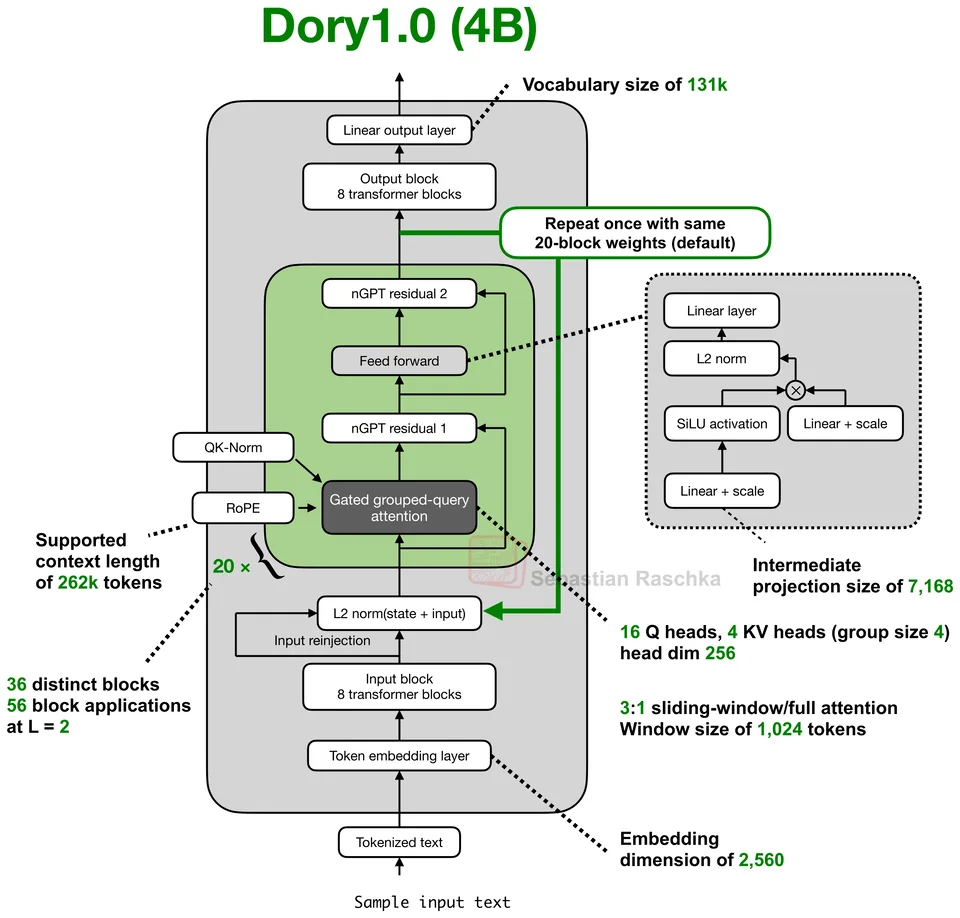
NVIDIA, released 2026-10-16. Dense decoder, 4B parameters, 256K context. Attention: Gated GQA; 3:1 sliding-window/full, RoPE.
Residual stream · Looped depth
The same blocks are applied several times, reusing weights across depth.
With L distinct blocks applied T times, the model gets L × T effective layers for the parameter cost of L. It is depth-wise weight tying, sometimes called recurrent depth.
Nanbeige 4.2 uses two fixed passes, Ouro uses four passes with a learned exit gate, and Dory1.0 loops a shared middle stack.
Models in the atlas using Looped depth, per half-year of release.
NVIDIA, released 2026-10-16. Dense decoder, 4B parameters, 256K context. Attention: Gated GQA; 3:1 sliding-window/full, RoPE.

BOSS Zhipin, released 2026-07-21. Dense decoder, 4B parameters, 256K context. Attention: GQA with RoPE.
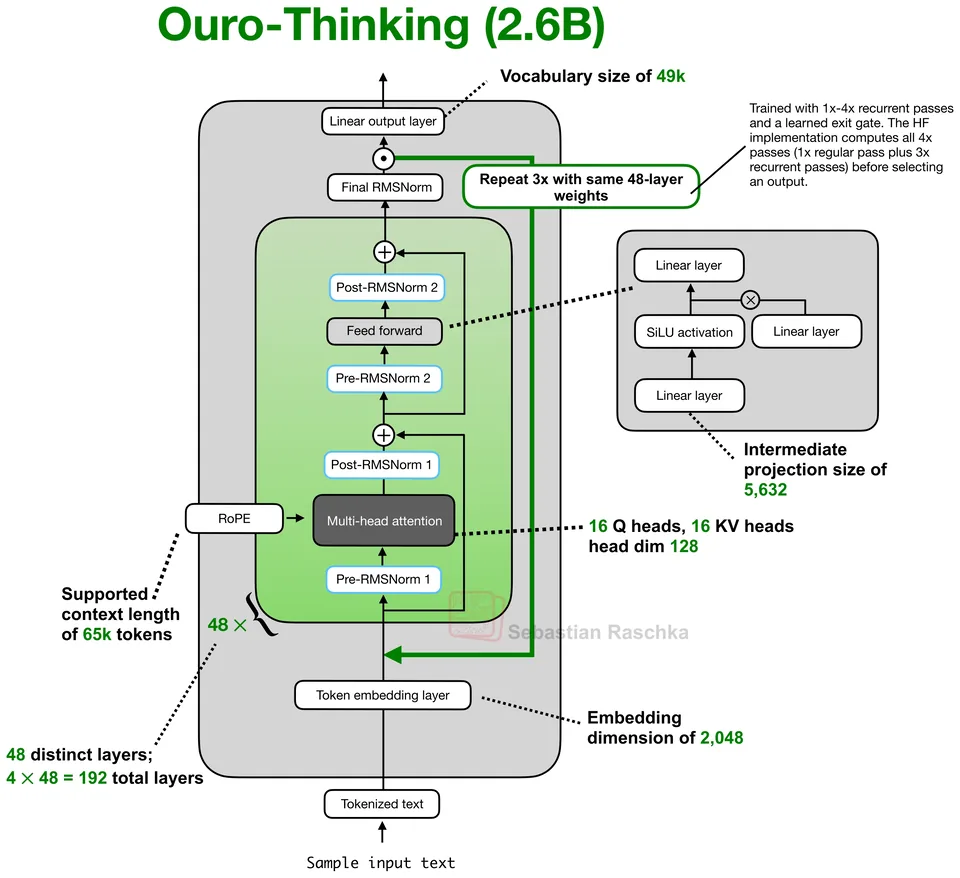
ByteDance, released 2025-10-29. Dense decoder, 2.6B parameters, 64K context. Attention: MHA with RoPE.
Jump to a model, concept or page